

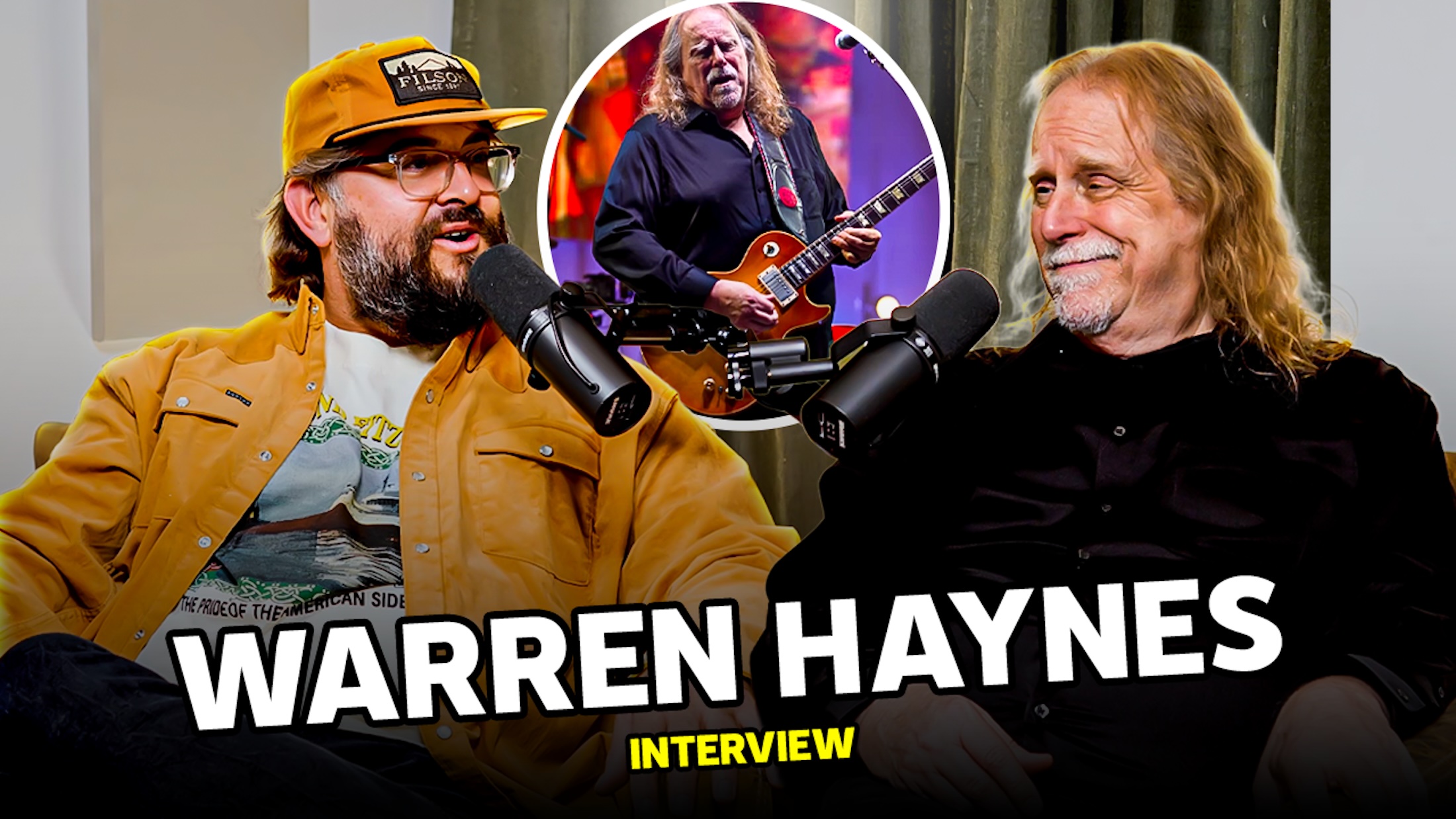
Warren Haynes is shaking a relentless Los Angeles rainstorm off his shoulders inside a studio on the Sunset Strip. He is in town to play two nights at the newish Blue Note Los Angeles on his first-ever solo tour, part of the “Winter of Warren” trek that is currently winding its way across the country.
But the irony of the current forecast is almost too on the nose to ignore. Here is the man who wrote “Soulshine,” the definitive instruction manual for finding light when the clouds move in. Yet the clouds have not just moved in; they have taken up a dismal, gloomy residence in a winter California storm.
Haynes, who has a reputation as being one of the kindest, most hardworking troubadours in the music business, is unbothered. It is a fittingly moody backdrop for a man who physically and sonically resembles a mountain that learned to sing the blues.
We are ostensibly here to discuss The Whisper Sessions, a stripped-down companion to his latest solo record, Million Voices Whisper, but the conversation quickly pivots to a different kind of excavation. Just a few weeks prior, Haynes released a massive, remixed and remastered edition of his 1993 debut, Tales of Ordinary Madness. It’s an album I have deeply loved for years, an essential piece of the rock canon that I’ve been listening to nonstop for the past week just to reacquaint myself with its brilliant, blues-soaked corners. For Haynes, however, it is a project that has been haunting him for decades, a piece of his history that he finally feels ready to rewrite.
But moments after we settle in to record our podcast, Haynes, a man whose resume reads like a frantic corkboard diagram connecting the Allman Brothers, the Dead, and the modern jam scene, casually drops a detail that stops the conversation cold.
TAP TO WATCH MY CONVERSATION WITH WARREN HAYNES ON THE BROBIBLE YOUTUBE:
https://youtu.be/YCQ6_r9axl4
“I’ve done a handful of dates here and there, but never done a tour,” Haynes says, his voice a low, gravelly rumble that sounds like tires on a gravel driveway.
He is talking about touring solo. Just Warren. No Mule. No Brothers.
“It’s kind of mind-blowing,” he admits, leaning back. “Nothing like doing your first one in front of thousands of people.”
He’s referring to a set at Bonnaroo back in 2003. That performance was so unexpectedly potent it was later released as his Live at Bonnaroo acoustic album. Cass, our editor-in-chief here at BroBible, was in attendance, all of us much younger versions of ourselves. For Haynes, it was a trial-by-fire moment that has finally, two decades later, evolved into a proper trek. Considering he has spent the last forty years serving as the structural steel of American rock music—the guy you call when a tour needs saving, or a band needs resurrecting—the idea that he has never just packed a van and played his own songs alone is baffling.
“I feel like having the different things keeps me from going nuts,” he says with the casual demeanor of a man who juggles chainsaws to relax. “I would get stagnated if I was just doing one thing all the time.”
To understand Haynes is to understand that “stagnation” is his only true enemy. He is a shark that must keep swimming, or in this case, a guitarist who must keep playing, singing, jamming, writing, and performing, lest his calluses go soft. But to really get the lore, and to understand why this man is the keeper of the flame for two of the most rabid fanbases in history, as well as the cultural mantle Gov’t Mule sits on (a subject I admittedly kick myself for not having enough time to fully explore with him today), you have to ignore the solo tour for a second and go back to the bus.
The Bus to Nowhere (and Everywhere)
The year was 1989. Haynes was ready to be a star on his own terms. He had the songs. He had the management. He was shopping a solo deal. And then, the phone rang. It was the Allman Brothers Band.
At the time, the Allmans were defined as much by their volatility as their virtuosity. They were broken up, and the feud between Dickey Betts and the rest of the camp was legendary stuff: Greek tragedy with slide guitars.
“I just took them at their word, ‘This is never going to happen,’” Haynes recalls of the rumors of a reunion. “So when I got that call, I was as shocked as anyone. But I was like, ‘Well, I guess I’m going to postpone my solo record yet again.’”
It was supposed to be a victory lap. One tour. Instead, the chemistry clicked. Haynes, playing alongside the late, great Allen Woody on bass, injected a new, muscular vitality into the band.
“The band sounded fantastic,” Haynes says. “So it turned into, ‘Hey, why don’t we do this again next year? And why don’t we do it again next year?’ And it wound up being 25 years for me.”
It was during this era, specifically on the bus shared by Haynes, Woody, and Gregg Allman, that the next chapter of rock history was inadvertently written. They were listening to Cream and Hendrix, the power trios of the late 60s.
“Somebody said, ‘You know, nobody does that anymore. There’s no improv trios like that,’” Haynes says. “And Woody made the comment, ‘You know, me and you and the right drummer could do that and bring it back.’”
That “right drummer” was Matt Abts. The result was Gov’t Mule.
“We were listening to music on the bus going down the highway… listening to music and laughing and hanging,” Haynes remembers. It sounds idyllic, almost pedestrian. But from those bus rides came a band that would bridge the gap between the southern rock aristocracy and the grimy, hard-rock underground.
It also gave Haynes license to be weird.
“Had I not joined the Allman Brothers and I was just a new name that nobody had ever heard before, it would be hard to get away with eight-minute songs and three-minute guitar solos,” Haynes admits. “But being part of the Allman Brothers gave me permission to do that.”
Tales from the Vault
But before the Mule could truly gallop, there was the matter of that postponed solo record. It would take four years of Allman Brothers touring before Haynes finally found the window to release Tales of Ordinary Madness in 1993. Produced by keyboard legend (and Rolling Stones musical director) Chuck Leavell, it was a critical darling. Rolling Stone called it a “powerful solo debut,” but sonically, it was a product of its time.
“Records recorded in the early 90s still had a lot of reverb and a lot of compression,” Haynes says. He always wanted to strip that away, noting he wanted the album to sound “more like a 70s record.”
Now, over 30 years later, he finally has. On January 30, Haynes released a remixed and remastered version of the album, stripped of the era’s gloss by mixer Jim Scott. It’s a project that has been in the back of his mind for decades, finally brought to life thanks to a chance encounter with Megaforce Records’ Missy Callazzo at a benefit in New York.
The reissue also unearths “Tear Me Down,” a track left on the cutting-room floor in ’93 due to budget constraints, despite featuring the legendary, now-departed Bernie Worrell on keys and Randall Bramlett on sax.
“We were over budget and out of time,” Haynes explains. “I haven’t heard what was on those tracks for 30 years… until I went in the studio and was able to choose.”
It’s a full-circle moment for a song that eventually found its way into Gov’t Mule’s live sets but never quite fit the Tales puzzle until now. Hearing it today, slotted into the sequence where it was always intended to be, feels like recovering a lost memory.
Forcing the Magic vs. Waiting for It
If the Allman Brothers Band was Haynes’ bachelor’s degree, and Gov’t Mule his master’s, the Grateful Dead became his doctoral work in metaphysics.
In the late 90s, Phil Lesh, the Dead’s bassist and sonic architect, called Haynes. Lesh was assembling a roster of musicians to reinterpret the Dead’s catalog. He didn’t want a cover band. He didn’t want a Jerry Garcia clone.
“He said, ‘If there’s something like that that you’re used to hearing a certain way, change it. Play it differently,’” Haynes says.
This is where the lore gets thick. Haynes found himself straddling two distinct philosophies of improvisation. On one side, you had the Allman Brothers: precise, aggressive, a locomotive that stayed on the tracks through sheer force of will. On the other, the Grateful Dead: a cloud that might rain, might thunder, or might just dissipate into mist.
Haynes recounts a conversation with Dickey Betts that perfectly encapsulates this dichotomy.
“Dickey Betts and I had this conversation one time where he said, ‘You know the difference between us and the Dead? We force the magic to happen, and the Dead wait on the magic to happen.’”
Haynes pauses, letting the quote hang in the air like cigar smoke. “And we were both agreeing that both things are equally beautiful, but they’re different.”
“I used to not know what it meant when people would talk about waiting several shows to feel that one big apex… ‘Oh, show number seven, man. That’s when it really started to happen,’” Haynes laughs. “There was something about the way they learned to play together… that let the music be what it was going to be. Don’t force it to be different.”
Playing with the Dead required a different toolkit. Literally. You can’t bring a sledgehammer to a seance.
“I wanted to have a different tone in each of the situations,” Haynes explains. His guitar tech, the late Brian Farmer, had Gibson build a Firebird with mini-humbuckers to cut through the sonic sludge differently than Haynes’ trademark Les Paul.
“Farmer used to name all my guitars… he didn’t ask me what they should be called,” Haynes says. “That guitar, it still has the label on it. It says ‘Dead Bird.’ And that’s the guitar that I played on that tour.”
The Ones That Got Away
For a man who has played with the living gods of rock, Haynes is surprisingly haunted by the ghosts of the ones he missed.
He saw the Grateful Dead three times. The first, in 1979, he was 19 and didn’t get it. “I wasn’t a Deadhead,” he admits. The second, in 1989 at Foxboro, he arrived late and only saw the second set. The third was a show at Madison Square Garden where Bruce Hornsby invited him to watch from the stage.
“Someone came up and said, ‘Hey, you want to go meet Jerry and say hi?’” Haynes recalls. “He wasn’t having a great night. I can tell. I could tell there was tension. And I saw, ‘Nah, I think I’ll wait till next time.’”
He looks down. “And it was a mistake on my part. There was no next time.”
It is a recurring theme. He saw Stevie Ray Vaughan play three times. He had chances to introduce himself. He didn’t. “Back then, I was even more shy than I am now, and I didn’t want to be the person that’s in the way,” he says.
It was a gracious move that shows Warren’s gentle humility. And it explains, perhaps, why he says yes to everything now. Why he played with Phil Lesh and Bob Weir. Why he tours relentlessly. Why he is finally doing the solo tour.
He knows, better than most, that the “next time” is a lie we tell ourselves to feel comfortable with procrastination.
The Secret Origin of “Soulshine”
We have to talk about “Soulshine.”
If you have been to a bar, a barbecue, or a fraternity lawn in the South in the last 30 years, you have heard “Soulshine.” It is the “Hey Jude” of Southern Rock. For years, casual fans assumed it was an old Allman Brothers standard, dug up from the archives of the 70s.
It wasn’t. It was Warren.
“I wrote Soulshine around ’87,” Haynes says. He tried to put it on his solo record, the very same Tales of Ordinary Madness we discussed, but even with the extra time, it didn’t make the cut.
“Chuck Leavell and I felt like it didn’t really fit in with the rest of the record,” Haynes admits. It sat in a pile.
Then, during the recording of the Allmans’ Where It All Begins, the band found themselves in a rare position: they were ahead of schedule.
“Tom Dowd came into the studio… and he said, ‘Well, we still have some studio time. Is there anything anybody wants to record?’” Haynes mimics the legendary producer. “And Gregg goes, ‘Hey, man, let’s, let’s do your song, Soulshine.’”
Gregg Allman had a bootleg tape of Haynes’ demos. He had been listening to it.
“I knew he liked the song, but he had never brought up the possibility of it being an Allman Brothers song until that moment,” Haynes says. “So we had to learn it from scratch.”
It’s a perfect encapsulation of Haynes’ career: a song he wrote, made famous by a band he idolized, sung as a duet with one of his heroes, eventually becoming so ubiquitous that people forget he wrote it.
“I even have people go, ‘I love that Allman Brothers cover you’re doing,’” Haynes laughs. “I’m like, ‘It’s not a cover. I wrote that.’”
The House on Fire
Haynes is a gearhead, but he is a practical one. He views instruments as tools to excavate the sound in his head. But when I ask him the impossible question—your house is on fire, you can save one guitar—he doesn’t hesitate.
It’s not the “Dead Bird.” It’s not the signature models.
“I have a 1959 Les Paul that I’ve had for about 15 years,” he says reverently. “It’s just a beautiful, one-of-a-kind instrument… I don’t take it on the road. I just play it if I’m close to home.”
It is comforting to know that even Warren Haynes, a man who has spent his life on the road, keeps the best stuff for himself.
The Singer-Songwriter Sets the Scene
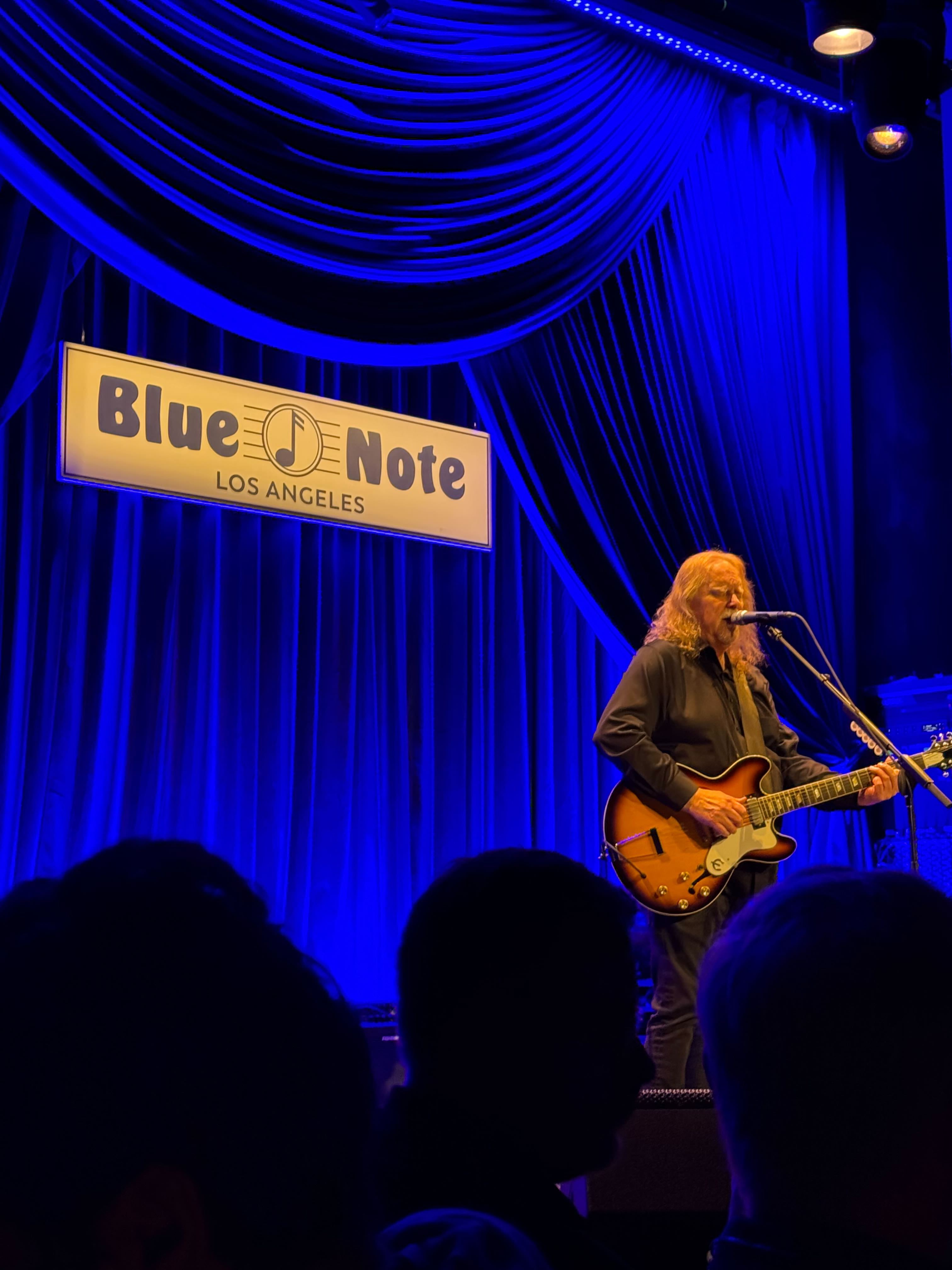
When I finally caught him at the Blue Note a few nights later, that gearhead pragmatism was on full display in the most intimate setting imaginable. Haynes walked out onto the stage armed not with the sprawling backline of a Gov’t Mule show, but with a simple trio of tools: his voice, a vintage acoustic, his trusty Gibson, and a 12-string Epiphone that chimed with a truly glorious, resonant sound, especially when he channels his Stevie Ray Vaughan with a slide.
In a room that holds just a few hundred people, he peeled back the layers of a half-century of music history. He opened with “Old Friend,” a nod to the Allmans, and immediately transitioned into a haunting cover of Fleetwood Mac’s “Gold Dust Woman.” He moved effortlessly from the traditional blues of “Time the Revelator” into the soaring Mule ballad “Life Before Insanity,” while making sure to weave in beloved Allman Brothers staples like “Melissa.” There were deep cuts like “Dusk Till Dawn,” stunning covers like Elmore James’ “The Sky Is Crying,” and an aching version of the William Bell soul classic “Everyday Will Be Like a Holiday.”
He closed the night with “Angel City,” his quintessential, poetic ode to Los Angeles. It was a fitting, melancholy closer for a rainy California evening, perfectly capturing the beautiful, tragic dichotomy of the city lying just outside the venue’s doors: “Homes that look like mansions / Not so far away from the cardboard ones / That make our streets unclean… Guess the angel I had on my shoulder / Stayed back in my hometown / And here in angel city / There just ain’t enough angels to go around.”
It was a staggering reminder of why this tour is so special. Stripped of the amplifiers, the light shows, and the legendary bandmates, what remains is simply one of the greatest interpreters of American music standing alone in the spotlight.
That life on the road has intersected with my own in ways I’ll never forget. I share my own piece of Warren Haynes lore with him: In 2008, I was a student at Penn State when The Dead played a massive gig at the Bryce Jordan Center in State College to raise money for the Obama campaign. The Allman Brothers opened the show. Haynes played both sets, an absolute marathon of guitar mastery in front of a packed arena. It was the fourth time I saw Haynes work his live magic: The first time with Phil and Friends at Hershey Park Stadium in 2002, followed by a Gov’t Mule at Penn’s Landing in 2005, and an Allman Brothers Band show at the York Fair.
“I have such fond memories of that show,” he smiles. “It was a big blur, because I played both sets… but that led to that reunion tour, which was really just such an honor for me to do.” Hearing him play that night, shifting seamlessly between two monolithic catalogs, was the quintessential showcase of a man who refuses to simply mimic his heroes. He was the quintessential “Don’t be Jerry.” He was just Warren.
When I ask him to name three albums that shaped him the most, his answer reinforces this connective web. He immediately names the Allman Brothers’ Live at Fillmore East and Little Feat’s live masterpiece Waiting for Columbus. But his third pick is a curveball: Steely Dan’s The Royal Scam. He marvels at Larry Carlton’s guitar work on what he considers the band’s last true rock record.
But the real magic is the hidden thread. Haynes recalls a conversation he had with the late Walter Becker while rehearsing in New York. “Walter told me that he and Donald Fagen used to go see the Allman Brothers at Fillmore East,” Haynes says, the revelation still bringing a smile to his face. “He said, ‘We went into Fillmore East one night and saw the Allman Brothers, and it blew our fucking minds.’ It was the first time I realized that they were Allman Brothers fans.”
That mutual admiration eventually led to Fagen himself sitting in with the Allman Brothers years later. And the song Fagen specifically requested to play? The Grateful Dead’s “Shakedown Street.”
“It was his idea,” Haynes says, still amused by the cosmic absurdity of the Steely Dan frontman calling a Dead tune with the Allman Brothers. “In hindsight, it makes sense… it made me realize that they’re connected in some way.”
It’s all connected. The tight Steely Dan licks tracing back to the Fillmore East; the Allmans leading to the Mule; the Mule coexisting with the Dead. And at the center of it all is Haynes.
“We’ll Make It Work”
As the rain finally pauses outside the studio around nightfall, Haynes mentions a moment from years ago. The dates blur when you play 200 shows a year, but the Dead had offered him a tour. His schedule was already packed with Gov’t Mule and the Allman Brothers. He was going to say no. He told his wife, Stefani, that he just couldn’t do it.
“She said, ‘Slow down,’” Haynes recalls. “She said, ‘Think about it like this. Are you going to want to look back years from now and think I had the opportunity to do this, but I didn’t do it?’”
He realized she was right.
“She was like, ‘We’ll make it work.’”
That seems to be the ethos. Whether it’s forcing the magic with the Allmans, waiting for the magic with the Dead, or stripping it all down to a single acoustic guitar for a solo tour at the age of 64.
You make it work. You get on the bus. You play the gig.
Because you never know if there’s going to be a next time.
The post Warren Haynes on the Dead, the Allmans, and Finally Going Solo at 64 appeared first on BroBible.
Warren Haynes on the Dead, the Allmans, and Finally Going Solo at 64
Pinoy Human Rights


0 Comments